Discover NASA with CTSGC
Discover NASA with CTSGC is a virtual speaker series that connects students, educators, and STEM enthusiasts with NASA professionals from across the agency. Through monthly online sessions, participants have the opportunity to learn directly from scientists, engineers, researchers, and other NASA experts who are helping shape the future of space exploration, aeronautics, technology, and discovery.
Each session features a NASA guest speaker and is moderated by a member of the Connecticut Space Grant Consortium (CTSGC). Speakers share insights into their careers, current projects, research initiatives, and the many ways NASA is advancing science and exploration. Participants will also have the opportunity to engage with presenters through a live question-and-answer session.
Whether you are exploring careers in STEM, interested in NASA missions, or simply curious about the future of space exploration, Discover NASA with CTSGC offers a unique opportunity to hear directly from professionals working at the forefront of innovation.
Register to Participate
Participation is free, but advance registration is required.
Registration Requirements
- Register online using the following form: https://forms.gle/BoXHb1W1u2LpAW7C7
- Participants must register using their college or university email address.
- Registration for each session closes the day before the scheduled event.
- A meeting link and participation instructions will be emailed to registered participants prior to the session.
Why Participate?
Participants will have the opportunity to:
- Learn about current NASA missions, programs, and research initiatives.
- Explore career paths in science, technology, engineering, mathematics, and aerospace.
- Hear firsthand experiences from NASA scientists, engineers, and professionals.
- Gain insights into internships, research opportunities, and workforce development programs.
- Connect with other students and members of the Connecticut STEM community.
- Ask questions and engage directly with NASA experts.
Who Should Attend?
Discover NASA with CTSGC is open to:
- Undergraduate and graduate students
- Community college students
- Faculty and educators
- CTSGC award recipients
We invite you to join us throughout the year as we explore the people, missions, technologies, and discoveries that are shaping the future of NASA and inspiring the next generation of explorers and innovators.
Ways to Participate
Discover NASA with CTSGC is designed to be flexible and accessible. Whether you are attending individually, participating with classmates, or organizing a group event on your campus, there are many ways to engage with each session.
Individual Participation
Students, faculty, staff, and STEM enthusiasts are welcome to attend sessions independently.
Participants can:
- Attend from their own computer or mobile device.
- Engage directly with NASA speakers during the live question-and-answer session.
- Explore NASA careers, missions, and research topics that align with their academic and professional interests.
- Participate from any location with an internet connection.
Student Clubs and Organizations
Student organizations are encouraged to host group viewing events on their campus.
Examples include:
- Engineering and technology clubs
- Astronomy clubs
- Robotics teams
- Women in STEM organizations
- Society chapters (ASME, IEEE, SWE, NSBE, SHPE, etc.)
- Honors programs and learning communities
Hosting a group viewing event can help foster discussion, networking, and engagement among students interested in STEM and aerospace topics. Clubs may also choose to organize follow-up discussions related to the session topic.
Faculty and Classroom Participation
Faculty members are encouraged to incorporate Discover NASA sessions into their courses when appropriate.
Faculty may:
- Use a session as a class enrichment activity.
- Invite students to attend as part of a course assignment or discussion.
- Host a live viewing during scheduled class time.
- Incorporate session content into lessons related to engineering, physics, astronomy, computer science, mathematics, aviation, aerospace, or other STEM disciplines.
These sessions provide students with the opportunity to hear directly from NASA professionals about current missions, cutting-edge research, and real-world STEM careers.
Campus Watch Parties
Institutions may also choose to organize larger campus viewing events that bring together students, faculty, and staff from multiple academic programs.
Campus watch parties are a great way to:
- Build STEM community on campus.
- Introduce students to NASA programs and opportunities.
- Encourage interdisciplinary conversations across STEM fields.
- Connect students with professionals working at the forefront of space exploration and innovation.
No matter how you choose to participate, Discover NASA with CTSGC offers a unique opportunity to connect with NASA professionals, explore emerging technologies and missions, and gain insight into the educational and career pathways that support the future of aerospace and STEM.
Next Session:
Next Session Details:
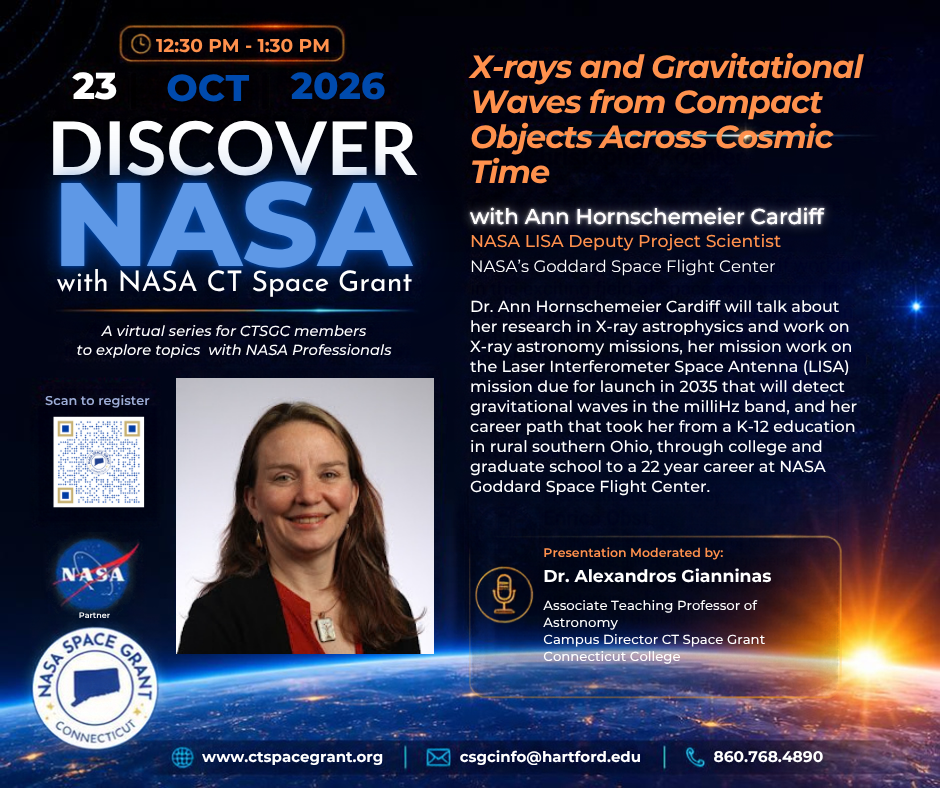
October 23, 2026
Ann Hornschemeier Cardiff
NASA LISA Deputy Project Scientist
NASA Goddard Space Flight Center
Dr. Hornschemeier Cardiff specializes in studies of X-ray emission from accreting black hole and neutron star binary populations, both in the local universe and at earlier times in the Universe. This work is carried out using surveys by space-based X-ray, UV, and infrared observatories as well as ground-based telescopes, working in coordination with theorists. She works on observations of nearby galaxies with NuSTAR, Chandra, XMM-Newton and Swift with a team of approximately ten scientists both at NASA Goddard Space Flight Center (GSFC) and universities.
Dr. Hornschemeier Cardiff currently serves as the Deputy Project Scientist for NASA’s Laser Interferometry Space Antenna (LISA) Project. LISA is a space-based gravitational wave mission led by the European Space Agency (ESA), with significant NASA contribution, due for launch in 2035. Dr. Hornschemeier Cardiff’s responsibilities include working with the NASA Project team on mission formulation, focusing on its Science Ground Segment, with the international ESA-NASA LISA Science Team as one of the co-chairs, supporting the Project Scientist, and on
communications both internally within NASA to Headquarters, GSFC and other Centers, as well as externally with the scientific community.
Dr. Hornschemeier Cardiff joined NASA’s GSFC as a civil servant astrophysicist in 2004, after spending two years as a NASA Chandra Fellow at Johns Hopkins University. Her PhD is from the Penn State Department of Astronomy and Astrophysics. She has been heavily involved in high energy missions and programs this entire time, and currently serves as the only U.S. Science Team member for the Wide Field Imager (WFI) instrument on the ESA's NewAthena X-ray observatory. She also served on the National Academies’ Decadal Survey on Astronomy and Astrophysics (Astro2020) Panel on Galaxies.
Dr. Ann Hornschemeier Cardiff's research concerns neutron star and black hole binary populations over cosmic time, observed in the X-ray band and at other wavelengths. Thee compact objects, neutron stars and black holes, are the end points of the lives of massive stars. She is on the science team of the NewAthena Wide Field Imager and will discuss next generation X-ray observations of our big sister galaxy neighbor, Andromeda. The Laser Interferometer Space Antenna (LISA) mission on which she works is an ESA-NASA collaboration, due for launch in 2035, that will be able to detect black holes, compact object binaries in the Milky Way, and many other interesting source classes. Her career began with K-12 education in rural southern Ohio, undergraduate studies at Drake University in Des Moines, Iowa including summer internships in Pennsylvania and North Carolina, and then graduate work at Penn State. She did a postdoctoral fellowship at Johns Hopkins in Baltimore, MD before starting her 22 year career at NASA. Ann will discuss the research, missions and career path that led to where she is today.
Join us for this exciting discussion!
Register to join the conversation: https://forms.gle/Nov1bSnkMBgZnByM7
2024/2025 Sessions:
Erin Reed
Piyumi Wijesekara
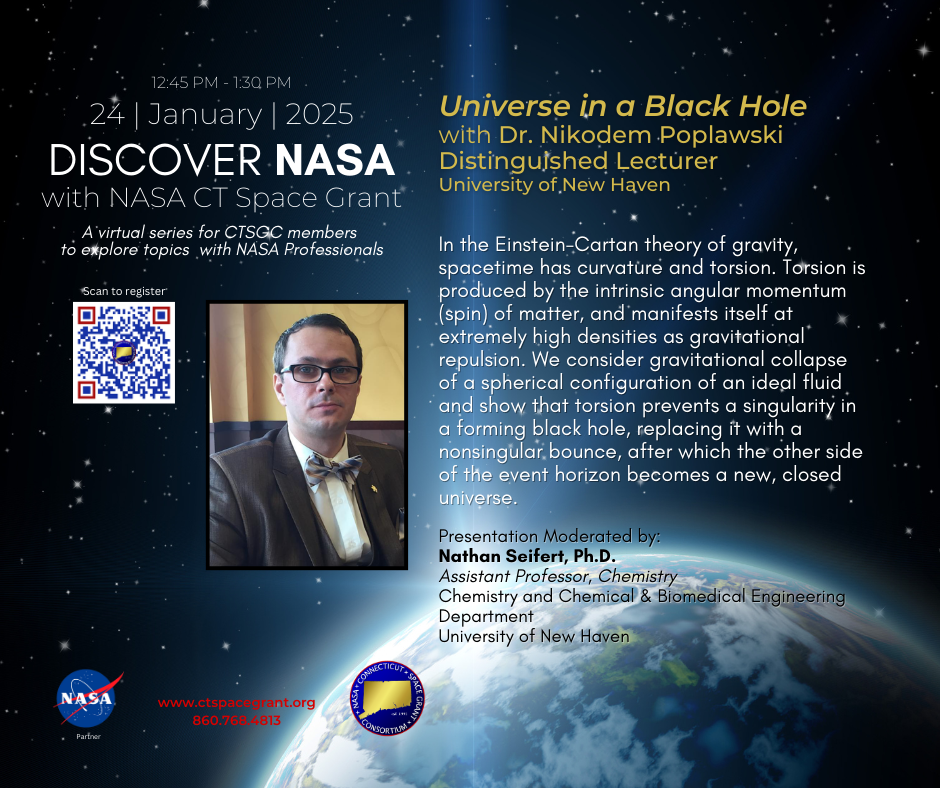
Nikodem Poplawski
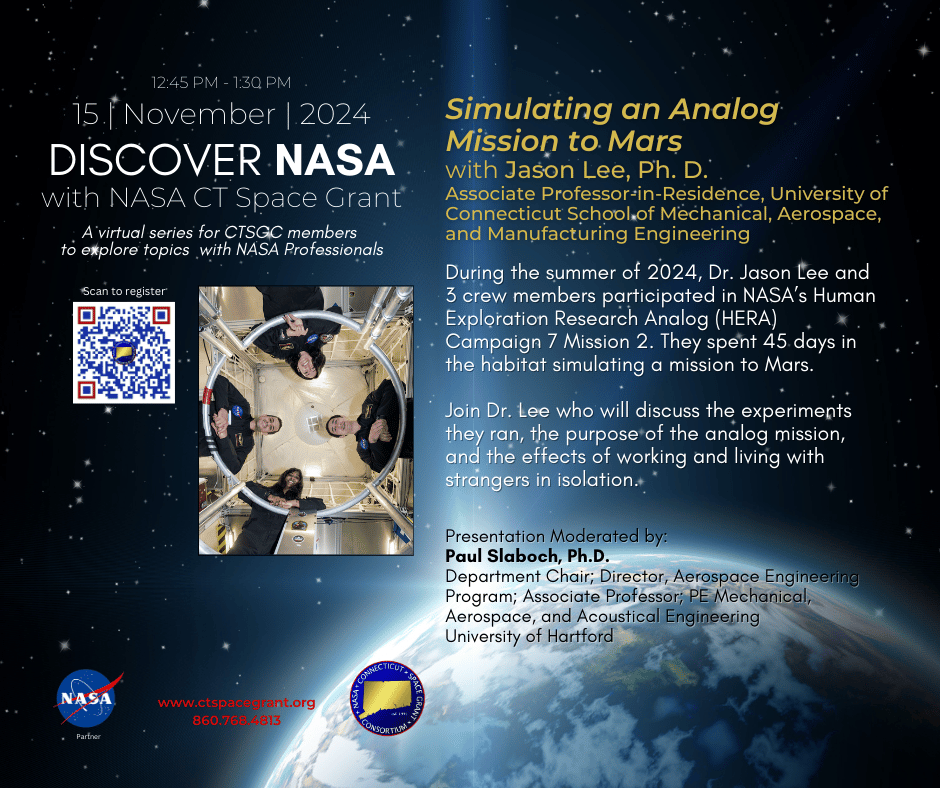
Jason Lee

Jordan Greco
2023/2024 Sessions:
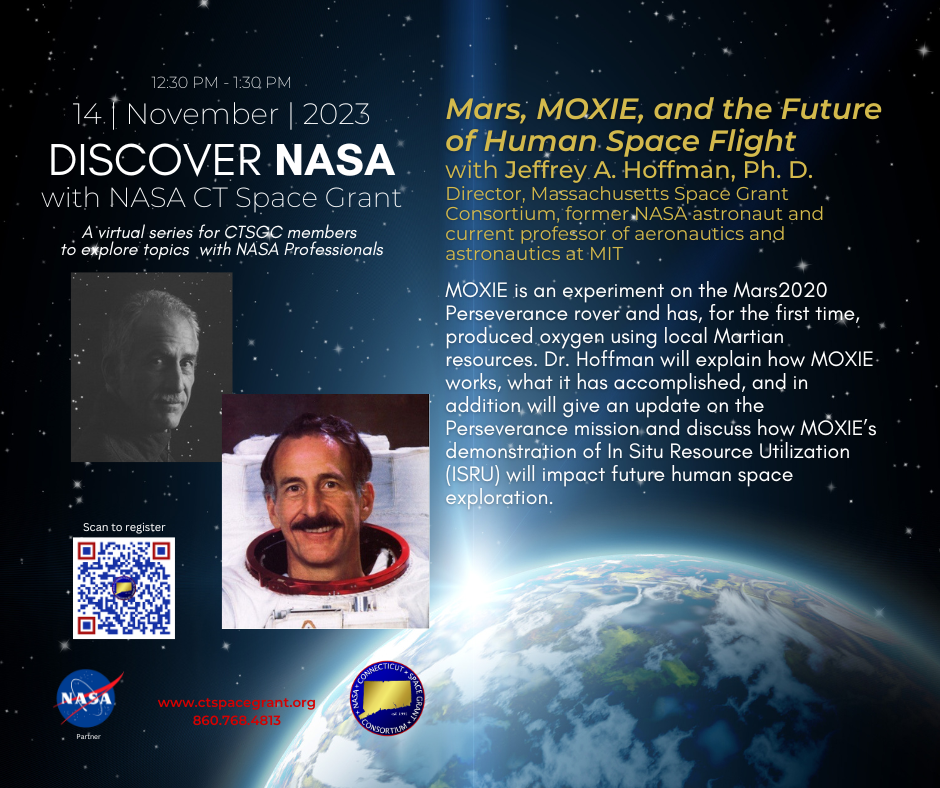
Jeffrey Hoffman
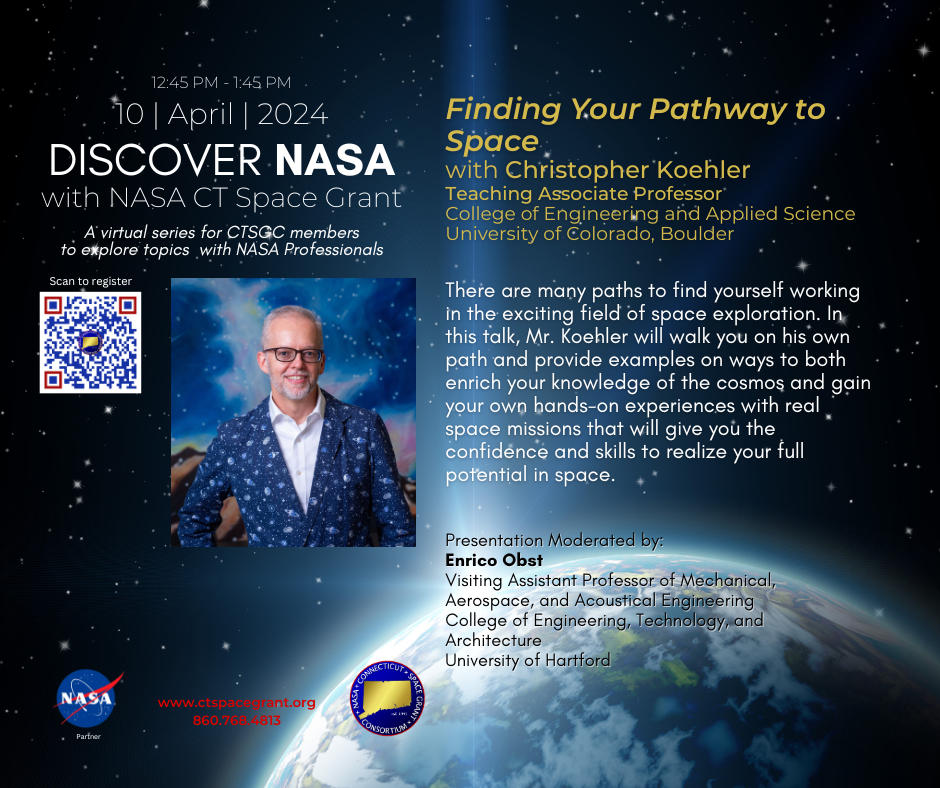
Chris Koehler (1)
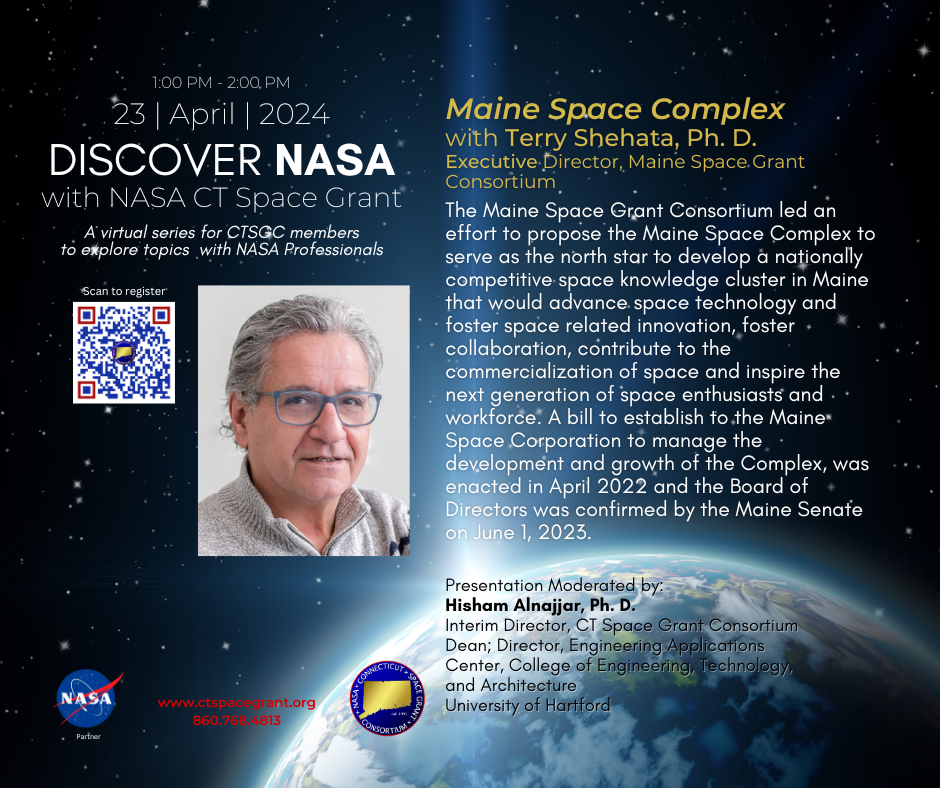
Terry Shehata (1)
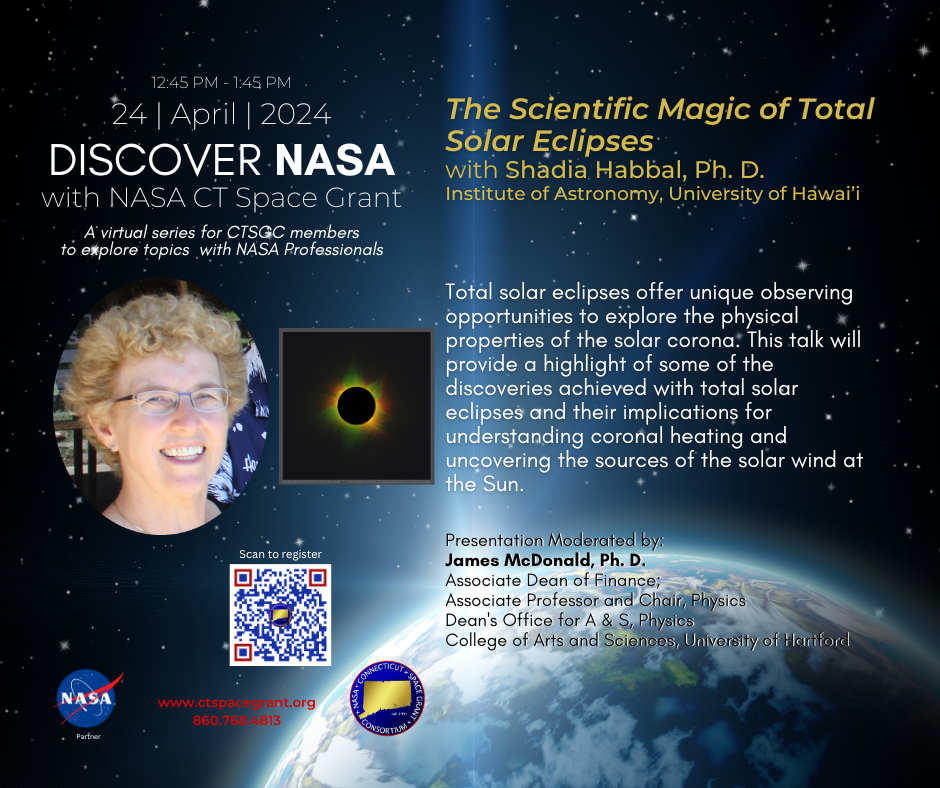
Shadia Habbal
2022/2023 Sessions:
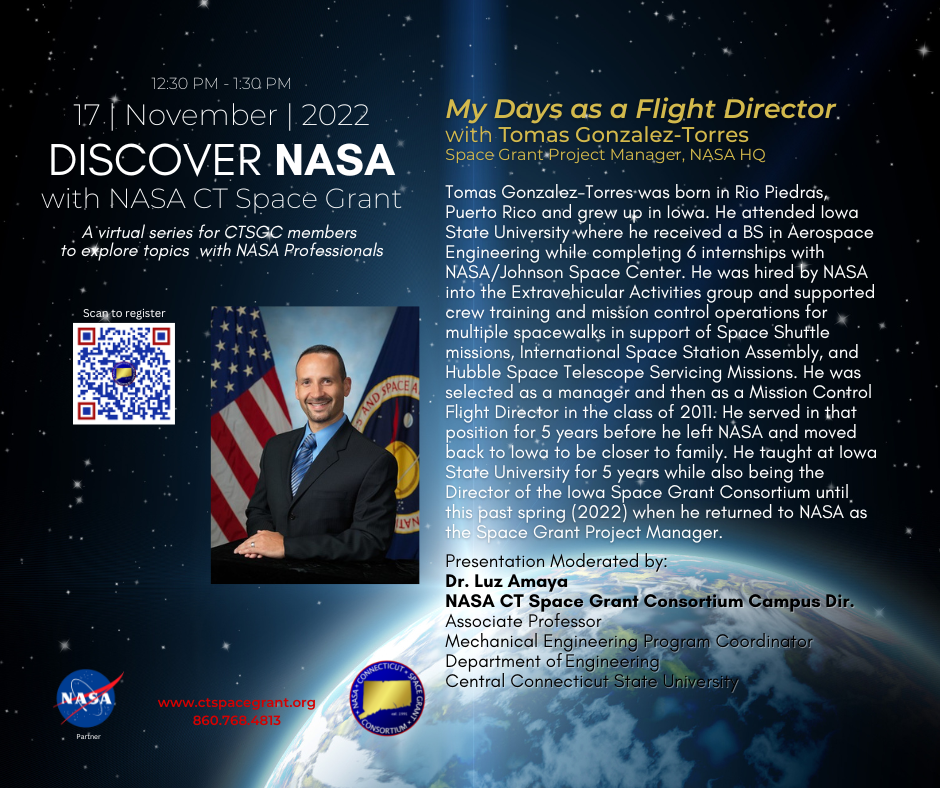
Tomas Gonzalez-Torres
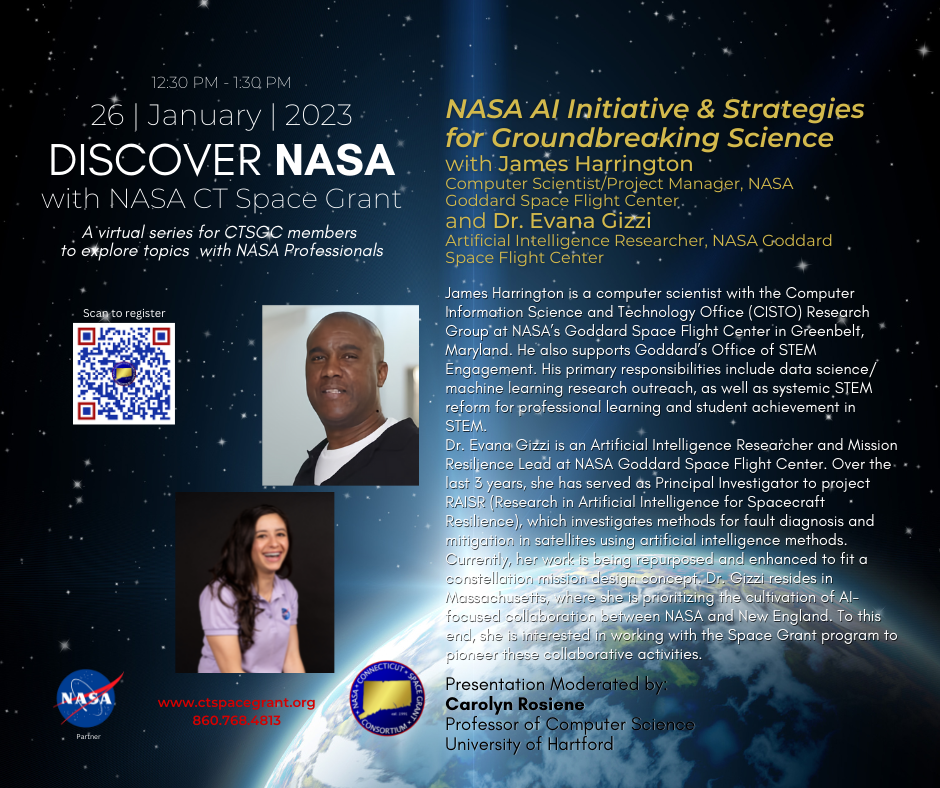
James Harrington_Evana Gizzi
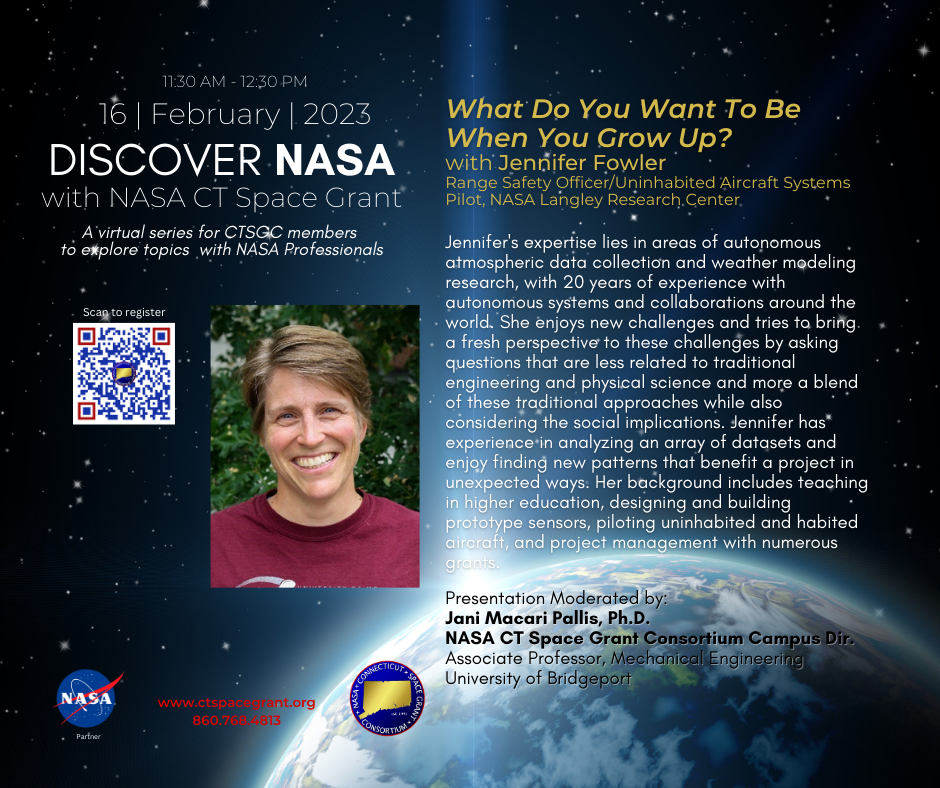
Jennifer Fowler
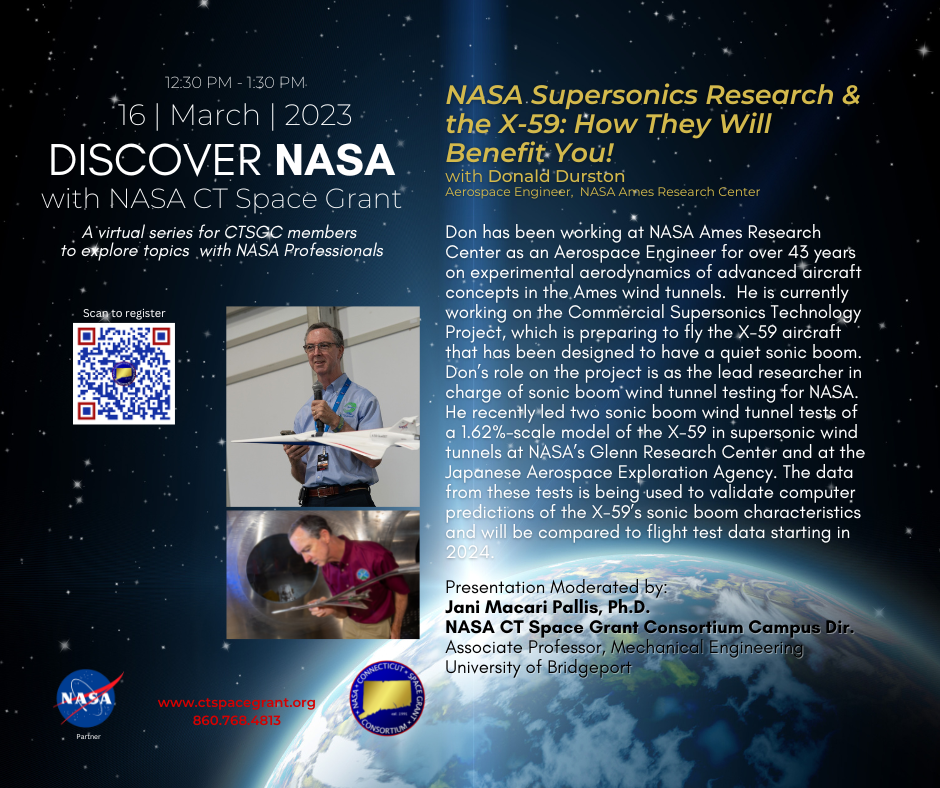
Donald Durston
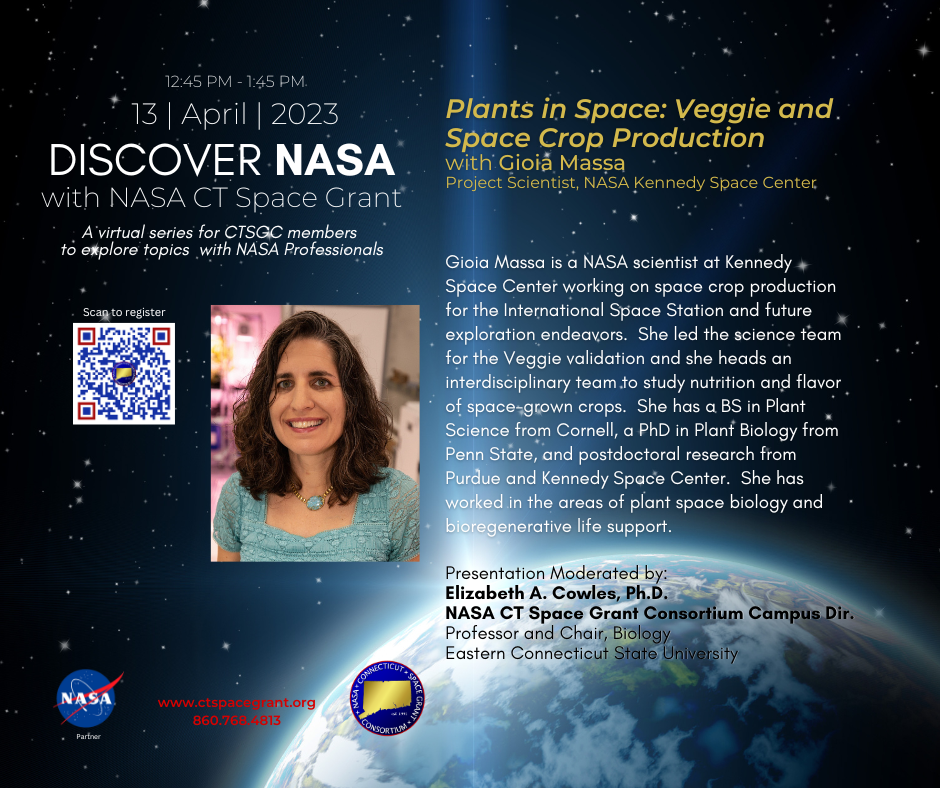
Gioia Massa
If you are interested in a recording of one of our past sessions to share as the host of a watch party, please contact your CTSGC Campus Director for information.